myBCN

Walk the story of Gaudí and the roots of Barcelona’s architectural revolution in about 2.5 hours

Introduction to Gaudí's Life & Work Walking Tour

Discover Gaudí’s life, his mentors, and the movement that reshaped Barcelona. Walk from the Palau de la Música to the Sagrada Família, and explore how Modernisme transformed a city, and changed architecture forever.

Award-Winning

The Top-Selling Barcelona Airbnb Experience
with more than 2800 5-star reviews.

myBCN

Your Barcelona Experts & Storytellers

Small Team, Small Groups, Great Stories, Lasting Memories, Award-Winning Tours

Genious Genious

We have given the title to a madman or a genius; time will tell.

Elías Rogent Director of the Barcelona Provincial School of Architecture
Madman Madman
Starring

The Wonderous World of Gaudí

Antoni Gaudí i Cornet
Signature of Antoni Gaudí, Catalan Modernist architect
Without first doing the Old Town Gothic Quarter Walking Tour After first doing the Old Town Gothic Quarter Walking Tour

Why This Is the Perfect First Tour for Gaudí and Art Nouveau Lovers

This isn’t just a sightseeing stroll; it’s your key to understanding the spirit behind Barcelona’s most iconic buildings. Whether it’s your first time here or your first time hearing the name Modernisme, this tour brings the architecture to life with stories of Gaudí, his mentors, and the movement that made them legends.

We walk the creative corridor that shaped a city, from the Palau de la Música to the Sagrada Família. Expect bold façades, hidden connections, and the context you need to appreciate more than just the photos.

Why This Is the Ideal Follow-Up After Exploring the Old City

Already seen the Roman roots and medieval heart? This tour picks up the story right where Old Town leaves off, tracing how Barcelona reinvented itself through architecture, innovation, and visionaries like Gaudí.

We’ll connect the dots between past and present as we walk the golden avenue of Catalan Art Nouveau/Modernisme. From concert halls to dreamlike apartments, you’ll understand how a city went from Gothic shadows to bold, sunlit facades in just one generation.

Co-Starring

Also Featuring: Domènech and Puig

Lluís Domènech i Montaner
Josep Puig i Cadafalch
Signature of Lluís Domènech i Montaner, Catalan architect
Signature of Josep Puig i Cadafalch, Modernist architect
Architecture
From Historic Mansions to Sacred Dreams

The Architecture of Gaudí and His World

Barcelona is a city shaped by vision. From elegant concert halls to flowing stone façades and surreal towers, this journey through 50 years of architecture reveals the creative forces that turned architecture into art. Walk the avenue where ideas became icons, and the city redefined itself block by block.

Extraordinary
Outstanding Universal Value

Four Buildings are Part of Two UNESCO World Heritage Sites

For much of his early life, Antoni Gaudí lived in the shadow of bigger names such as Domènech i Montaner, Puig i Cadafalch, and others who were already shaping the city’s future. Today, four buildings on this walk are part of two different UNESCO World Heritage Sites, reminding us that Gaudí didn’t invent Modernisme alone but helped transform it into something extraordinary.

Locations
This is the Area We're Covering

An Art Nouveau Architecture Tour

From whimsical rooftops to intricate façades, this walk traces the transformation of Barcelona through the life and vision of Antoni Gaudí. You’ll follow the footsteps of Gaudí and his contemporaries as we move through elegant avenues, revolutionary buildings, and the creative boom of the Eixample. Along the way, you’ll explore the connections between Gaudí, his mentors, and rivals, and see how the city itself became their canvas. This is the story of Barcelona’s architectural revolution, told one stunning building at a time.

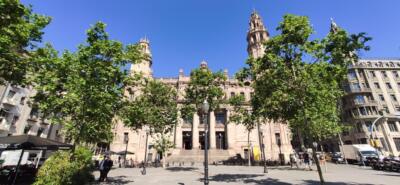
Bureaucracy Never Looked So Beautiful – Edificio de Correos y Telégrafos (Central Post Office)

Barcelona’s Edificio de Correos y Telégrafos, or Central Post Office, might be the only place where sending a package feels like stepping into a palace. Tucked between the bustling...

More
Neo-Gothic Bishop’s Bridge crossing Carrer del Bisbe in Barcelona’s Gothic Quarter, with ornate stonework and pointed arches.

Gothic Illusion in a Neo-Gothic Frame – Bishop’s Bridge

It looks centuries old, but Pont del Bisbe, or Bishop’s Bridge, is not quite what it seems. Spanning a narrow street in the Gothic Quarter like a stone whisper...

More
Roy Lichtenstein's colorful sculpture "El Cap de Barcelona" near Passeig de Colom with historic buildings in the background.

Pop Art Meets Port – Lichtenstein’s Face of Barcelona – Cap de Barcelona

Amidst the Roman ruins and medieval shadows of Barcelona’s Old Town, there’s one face that couldn’t care less about blending in. Roy Lichtenstein’s Cap de Barcelona, a 15-meter pop-art...

More
Plaça Antonio López in El Born, Barcelona, with view of the Llotja de Mar building and the empty pedestal where a removed monument once stood.

The Deal-Making Hall That Time Transformed – La Llotja de Barcelona

Long before skyscrapers and stock markets, La Llotja de Barcelona was where real business happened. Built as a medieval exchange hall just steps from the sea, this grand structure...

More
Rear view of the apse and bell tower of Barcelona Cathedral from Carrer de la Pietat, showing Gothic windows and gargoyles.

The Gothic Giant That Guards the Old City – Barcelona Cathedral

Rising above the winding alleys of the Gothic Quarter, the Barcelona Cathedral is a monumental blend of piety and power. Dedicated to Saint Eulàlia, the city’s co-patron saint, this...

More
Historic stone drinking fountain with three carved faces in Plaça Sant Just, Gothic Quarter, Barcelona.

The Oldest Fountain Still Flowing – Font de Sant Just

Tucked into a quiet corner of the Gothic Quarter, the Font de Sant Just is one of Barcelona’s oldest public fountains. Built in the 14th century in Gothic style,...

More

Antoni Gaudí
The Life That Shaped a Basilica and a City

From Apprentice to Architect of God

Gaudí’s journey is carved into the city itself; from brick workshops and school benches to dragon-backed rooftops and towering stone spires. His life mirrored Barcelona’s transformation, and his architecture reshaped its skyline. Scroll through the years to see how a reserved young artisan became the visionary behind one of the world’s most extraordinary buildings.

Birth of Antoni Gaudí1852

Antònia Cornet gives Birth of Antoni Gaudí

His mother is 33 and father 42 when he is born on June 25 in Reus or Riudoms. He was the youngest of five siblings, though only three survived into adulthood.

1852
Illness and Observation1863 (Age 11)

Rheumatism Shapes Worldview

Recurring illness forces young Antoni into long rest periods. He spends time observing nature, developing the eye of an organic designer.

1863 (Age 11)
Moves to Barcelona1868 (Age 16)

Gaudí Moves to the City

He moves from Reus to Barcelona with his brother Francesc (Age 17) for high school and university prep. The city’s energy and contrasts will inspire his work for life.

1868 (Age 16)
Begins Architecture School1873 (Age 21)

Gaudí Enters Escola d’Arquitectura

Begins formal training in architecture while working for professionals like Fontserè and Martorell.

1873 (Age 21)
Graduates and Meets Güell1878 (Age 26)

Gaudí Graduates, Meets Patron

Receives his degree. At the Paris World Expo, industrialist Eusebi Güell discovers his work—marking the start of a lifelong partnership.

1878 (Age 26)
Barcelona's Lampposts1879 (Age 27)

Illuminating the Cityscape

Right after graduating, Gaudí was awarded a commission to design lampposts for public squares like Plaça Reial. These lampposts marked his first contribution to public art.

1879 (Age 27)
Mataró Cooperative Design1879 (Age 27)

A Social Architecture Test Run

Designs buildings for a textile workers’ co-op. Though small in scale, it previews his idealistic visions of harmonious urban living.

1879 (Age 27)
Death of Sister Rosa1883 (Age 31)

Gaudí Becomes a Guardian

Sister Rosa dies (Age 40). Gaudí adopts and raises her daughter, Rosa Egea, (Age 1) showing his deep sense of duty despite his growing isolation.

1883 (Age 31)
Starts Casa Vicens and Takes Over Sagrada Família1883 (Age 31)

Two Catalan Icons Take Shape

Begins Casa Vicens and is asked to lead the Sagrada Família project, then a modest neo-Gothic church.

1883 (Age 31)
Begins Güell Pavilions1884 (Age 32)

Oriental Gateways and Fantasy

Builds ornamental stables and a dragon gate for Güell’s summer estate, showcasing exotic tastes and structural experimentation.

1884 (Age 32)
Begins Palau Güell1886 (Age 34)

Grand Townhouse on the Ramblas

Designs a noble mansion rich in materials and symbolism. Wins royal attention during the 1888 Barcelona Expo.

1886 (Age 34)
Death of Father Francesc Gaudí1889 (Age 37)

Last Parental Tie Broken

His father (Age ~79) dies after a long illness. Gaudí now has no living parents and increasingly retreats from society.

1889 (Age 37)
Completes College of the Teresians1894 (Age 42)

Monastic Architecture with Minimal Means

Builds a brick convent school for nuns, with vertical Gothic lines and near-total material austerity.

1894 (Age 42)
Work at Montserrat1895 (Age 43)

Shrine for the Virgin of Montserrat

Designs a Neo-Gothic camarín behind the Black Madonna’s altar. Though destroyed in the Civil War, it reflects his mystical devotion.

1895 (Age 43)
Begins Casa Calvet1898 (Age 46)

Classical Façade, Hidden Depths

A relatively traditional building for a textile manufacturer. Symbolism is embedded in every balcony and column.

1898 (Age 46)
Begins Park Güell1900 (Age 48)

From Garden City to Urban Fantasy

Designs a failed residential development that becomes one of Barcelona’s most surreal and beloved public spaces.

1900 (Age 48)
Begins Torre Bellesguard1901 (Age 49)

Medieval Revival on Sacred Ground

Pays homage to King Martí l’Humà by reimagining his old residence with Catalan Gothic and geometric purity.

1901 (Age 49)
Remodels Casa Batlló1904 (Age 52)

Gaudí's Dragon House

Reworks an apartment block with marine inspiration and curves. The roof resembles St. George’s dragon.

1904 (Age 52)
Starts Casa Milà (La Pedrera)1906 (Age 54)

Living Sculpture on Passeig de Gràcia

Creates a radical apartment building with no load-bearing walls and an iconic rooftop skyline.

1906 (Age 54)
Exhibits in Paris, Becomes Reclusive1910 (Age 58)

Praise Abroad, Withdrawal at Home

His work is shown in Paris, but Gaudí is uninterested in fame. He focuses instead on spirituality and solitude.

1910 (Age 58)
Death of the Niece Rosa Egea1912 (Age 60)

Loss of His Adoptive Daughter

The woman (Age ~30) he raised since 1883 died. Gaudí never had children, and she was his closest family connection.

1912 (Age 60)
Brother Salvador Dies1912 (Age 60)

Final Family Member Gone

Salvador (Age ~69), suffering from mental illness, dies in an asylum. Gaudí is now completely alone.

1912 (Age 60)
Devotes Life to Sagrada Família1914 (Age 62)

Monastic Life Begins

Rejects all other projects. Lives austerely and focuses entirely on completing the Sagrada Família as a sacred mission.

1914 (Age 62)
Advanced Design Work1915–1925 (Age 63–73)

Nature, Geometry, and Light

Perfects reverse-chained models and light studies for the basilica’s nave, generating forms rooted in divine proportion.

1915–1925 (Age 63–73)
Moves Into the Workshop1925 (Age 73)

Lives Inside His Creation

Leaves behind his flat to sleep inside Sagrada Família, dedicating every hour to God and architecture.

1925 (Age 73)
Death After Tram Accident1926 (Age 73)

A Humble Death, A Monumental Legacy

Struck by a tram on June 7. Died June 10, two weeks before his 74th birthday. Initially mistaken for a beggar due to his plain clothes. Buried in the crypt of the basilica.

1926 (Age 73)
Endurance
Uncelebrated, at first

From Craftsman to Legend

For much of his early life, Antoni Gaudí lived in the shadow of bigger names:

  • Not a darling of the academic elite like Domènech i Montaner

    While his classmates mastered historical styles and rationalist design, Gaudí stood apart—more artisan than theorist. His work was seen as eccentric, even excessive. He graduated without honors and without fanfare, his brilliance recognized by few.

  • Not a favorite of fashionable society

    In a city where wealthy patrons sought classical refinement or French elegance, Gaudí’s twisting chimneys and tiled beasts puzzled many. He lacked the charm of cosmopolitan architects and often clashed with clients. For years, he was seen as difficult, provincial, even unmarketable.

  • Not part of the European avant-garde

    While Art Nouveau bloomed in Paris and Vienna, Gaudí worked in Barcelona with local artisans, embedding Catalan folklore and Catholic symbolism into every stone. Critics abroad dismissed him as a regional curiosity—creative, perhaps, but unserious.

  • Not even respected by his own profession

    By the early 20th century, Gaudí was isolating himself. He refused new commissions, lived simply, and poured everything into a single unfinished basilica. Some called him a genius; many called him mad. Even in Barcelona, he was admired by few and understood by fewer.

And yet, Gaudí endured, quietly, stubbornly, obsessively.

He became an architect who chiselled nature into stone and who built gravity-defying spaces from hanging chains and faith. His buildings weren’t blueprints; they were visions, slowly rising while the world looked elsewhere.

Gaudí’s transformation didn’t come with applause but with time. He wasn’t celebrated in life; he was canonized by history.

That long, awkward stretch of misunderstanding is what makes his legacy so extraordinary today. This is not an architect born into glory. He earned it, tile by tile, brick by brick, with a chisel in one hand and a prayer in the other.

Pictures
Direct from Our Cameras

Photos of our Beloved Barcelona

All the photos you see here were taken by us, your local guides who host our walking tours across Barcelona. Most are snapshots from real experiences with our guests, capturing the authentic beauty of the city’s neighborhoods, from the Gothic Quarter to Gaudí’s landmarks. Use the filters to explore images from specific tours and discover what makes each area unique.

This is for You

Who This Tour Is For (And Not For)

  • Want to trace Gaudí’s journey from student to visionary

    Walk where he walked, from student days to visionary master, tracing the people and places that shaped his work.

  • Love storytelling, symbolism, and “What was he thinking?”

    We go beyond dates and styles to explore ideas, obsessions, and the wild imagination behind the facades.

  • Are curious about his rivals, collaborators, and early influences

    Meet the characters of the Modernisme movement: Domènech, Puig, Güell, and learn how they shaped and challenged each other.

  • Want a richer understanding of Gaudí’s life, not just his buildings

    This isn’t a façade-by-façade tour. It’s a story about faith, failure, genius, and grit, with Barcelona as the backdrop.

  • You enjoy walking through iconic streets and overlooked gems

    From Passeig de Gràcia to quiet courtyards, we blend famous landmarks with buildings most tours skip.

  • Prefer small-group conversations over scripted lectures

    No headsets, no scripts. All you get is a personable, conversational experience with a passionate local host.

  • You’re hoping to explore Barcelona’s origins or medieval history

    This tour doesn’t cover the ruins, Gothic Quarter, or early city legends; that’s our Old Town Gothic Quarter Walking Tour.

  • You’re looking for a Gaudí or Sagrada Família tour

    We focus on Gaudí and his world, not Barcelona’s neighborhoods or practical trip tips. That’s a different, and amazing, tour we also offer.

  • You expect to visit interiors like Sagrada Família or Casa Batlló

    This tour covers their background stories and how they came to be, but we don’t go inside. Want to? Reach out and ask, and we'll help you.

  • You're looking for a formal lecture on architectural theory

    We’re not academics, and this isn’t a classroom. We talk about ideas, not footnotes, and our focus is more on story than syllabus.

  • You expect a stop-and-go photo-op tour without deeper context

    If you're after postcard views and a checklist, this might feel too thoughtful or slow-paced.

  • You prefer audio headsets or large group formats

    We keep it intimate, flexible, and interactive, more like a conversation than a class.

Questions

FAQ

Frequently Asked Questions

What sights will we see on the tour?

We’ll pass more than 30 remarkable buildings and structures that shaped modern Barcelona, with Gaudí’s most iconic works as the highlights. Along the way, you’ll also encounter masterpieces by his mentors, collaborators, and rivals, such as Domènech i Montaner’s Palau de la Música, a UNESCO World Heritage Site, and Puig i Cadafalch’s striking Casa Amatller. From ornate lampposts and hidden details to architectural giants like Casa Batlló, Casa Milà, and the Sagrada Família, this walk reveals how a generation of visionaries transformed a city.

How long is the tour and how much walking is involved?

The tour lasts around 2.5 to 3 hours and covers about 3.5 kilometers, which is just over 2 miles. We walk at a relaxed pace with many stops along the way. Toward the very end, we take a short metro ride to reach the Sagrada Família. The metro ticket is included in the price, so there is no need to worry about buying one.

Where does the tour start and end?

We begin near Via Laietana in the Old Town and finish at the Sagrada Família. It's a linear route, not a loop, so you’ll end in a different part of the city than where you started, but right in front of one of the most iconic buildings in the world.

Do I need to book in advance?

Yes, advance booking is essential. We keep our groups small, and some tours sell out ahead of time. Booking early guarantees your spot and helps us keep the experience personal.

How do I pay for the tour?

Payment is required in full when you book. It’s quick and secure, and guarantees your spot on the tour. Once you're confirmed, just show up, we'll take care of the rest.

What language is the tour in?

All our public tours are in English. If you're looking for Spanish, Catalan, German or another language, just get in touch and we’ll let you know about private tour options.

Is this tour suitable for kids, seniors, or people with mobility concerns?

Yes. The route is step-free and mostly flat, and our hosts adjust the pace to suit the group. If someone in your group uses a wheelchair or has limited mobility, let us know in advance and we’ll make sure everything works for you.

What should I bring or wear?

Wear comfortable shoes and dress for the weather. In summer, bring water, sun protection, and a hat. In cooler months, bring a jacket. We run tours in light rain, so a small umbrella or waterproof layer can be useful too.

Does the tour run in bad weather?

Yes. We run rain or shine, unless the weather becomes unsafe. If we ever need to cancel due to extreme conditions, we’ll contact you as early as possible with options.

How big are the groups?

Group size is capped at 10 people. On average, we host 5 to 7 guests per tour. Small groups mean more flexibility, better storytelling, and time for real conversations.

Can I book a private or custom version of this tour?

Absolutely. Whether you're a couple, a family, or a group of colleagues, we can tailor the experience to your pace and interests. Private tours can also include extras like food stops or special themes. Just reach out and tell us what you’re looking for.

Do you pick up at my hotel or appartment?

No, we don’t offer hotel pick-up. The meeting point is central and easy to reach by metro, taxi, or on foot. Once you book, you'll get detailed instructions and a map link to help you get there stress-free.

Do we go inside any buildings on the tour?

No, this is an outdoor walking tour. Entering even one of the major buildings, such as Casa Batlló, Casa Milà, or the Sagrada Família, would take at least 45 to 90 minutes on its own and require separate timed-entry tickets. Most also cost over €25 per person. To keep the experience affordable, efficient, and focused on storytelling, we stay outside and dive into the history, symbolism, and context of what you’re seeing. Your host will point out which buildings are worth visiting later, how to get tickets, and what to expect inside.

Are we going to the Sagrada Família?

Yes, we end the tour right at the Sagrada Família. We don’t go inside, but you’ll get an in-depth look at the Nativity façade and the fascinating stories behind it. This includes Gaudí’s final years and what’s still being built today.

Will we see Gaudí’s famous buildings?

Yes, many of them. We include Casa Batlló, Casa Milà (La Pedrera), and the Sagrada Família, plus earlier works and lesser-known gems along the way. We also talk about the architects who inspired or challenged him, like Domènech i Montaner and Puig i Cadafalch.

What makes this tour different from others?

We don’t lecture or recite dates. This is a storytelling tour that puts Gaudí in context, with his city, his peers, and his time. You’ll come away understanding not just what he built, but why it mattered, how it was received, and what makes it magical even today. It’s personal, unscripted, and full of insight and humor.

Can I bring my child on the tour?

Absolutely. Kids are welcome as long as they’re comfortable walking for about two hours and enjoy storytelling. If you're traveling with toddlers or strollers, let us know and we’ll adapt the route as best we can.

Are there bathroom breaks during the tour?

There are no scheduled stops, but your host will happily point out clean, free bathrooms nearby before or after the tour.

Can I join the tour if I arrive late?

It’s your responsibility to be on time. We’ll send you a reminder before the meeting time to help you stay on track.

To be clear: If you’re late, there’s no way to catch up or reschedule once the tour has started. During the tour, I’ll fully focus on creating a great experience and won’t check my phone out of respect for other participants. So, please plan and arrive early!

Can we take photos during the tour?

Yes, definitely. There will be plenty of scenic and quirky moments along the way. Just be respectful of others in the group and avoid blocking narrow alleys.

Can I bring my dog?

Yes, please! We loooove dogs. As long as your pup is well-behaved, on a leash, and comfortable in small groups and urban environments, they’re more than welcome to join the walk. Just give us a heads-up when booking so your host knows to expect furry company.

How well do the hosts speak English?

All our hosts speak English fluently and confidently, at near-native level. While none of us are native speakers, we’ve been guiding international guests for years, and we communicate clearly, naturally, and with a lot of personality.

Are you locals?

Yes, we’re all proud locals. Some of us were born and raised in Barcelona, others have called it home for over a decade. We know the city like the back of our hand and love sharing stories you won’t find in the guidebooks.

Do we need a ticket to attend the tour?

No physical ticket is needed. Once you book online and receive your confirmation email, you’re all set. Just show up at the meeting point on time, no printouts, no QR codes, no fuss.

Host
Jana

Meet a co-Founder

Hi, I’m Jana, co-founder of myBCN. I’m originally from the City of a Thousand Spires and have been based in Barcelona for over 15 years. I speak several languages fluently, which has always helped me connect across cultures, whether guiding guests, traveling the world, or simply asking for snacks in obscure dialects.

Before this chapter, I studied International Business and worked for a global cosmetics company. But I eventually traded corporate strategy for cultural storytelling, turning my lifelong passion for travel and human connection into a full-time mission.

I created myBCN with Matt to offer something more personal than the average tour. I love making history feel human and helping guests connect with Barcelona in their own way, whether through architecture, local stories, or the charm of an unexpected side street. For me, hosting isn’t about performing; it’s about creating small, meaningful moments of curiosity and joy.

To date, I’ve explored over 50 countries and hundreds of UNESCO World Heritage Sites. Together with Matt, I’m on a mission to visit them all. You can follow our adventures on Instagram at @GuideVenturous.

Our Guests
This is What We are Doing

Barcelona Moments in Motion

Want a taste of what it’s like to join one of our Barcelona walking tours? Watch our Instagram Reels to experience moments from our tours, this time scripted but still unfiltered, and full of life. From Gaudí close-ups to Old Town surprises, these short clips capture the atmosphere, storytelling, and laughter that define the myBCN experience. Follow us on Instagram to see more and feel the spirit of Barcelona in every frame.

Our Guests
What Our Clients Are Saying

Here’s What Our Guests Think

We believe the best way to explore Barcelona is through powerful storytelling, and our guests agree. These reviews reflect what truly sets myBCN apart: hosts who bring the city’s history to life with humor, heart, and deep local insight. Every walking tour is more than a list of facts; it’s a meaningful journey that connects the past with today’s vibrant Barcelona. Read what travelers have shared after experiencing it first-hand.

Share Your Own Insights

Give us your Insights in a Review on:
Give us your AI Assisted Insights in a Review on: