myBCN

Walk Through 2,000 Years of Barcelona History in Just 2.5 Hours

Introduction to Barcelona's Old Town Gothic Quarter Walking Tour

Step into the winding alleys of the Gothic Quarter and discover Roman ruins, medieval secrets, and hidden gems, all with a passionate local host who makes the past come alive.

Award-Winning

The Top-Selling Barcelona Airbnb Experience
with more than 3000 5-star reviews.

myBCN

Your Barcelona Experts & Storytellers

Small Team, Small Groups, Great Stories, Lasting Memories, Award-Winning Tours

Why This Is the Perfect First Tour of Barcelona

This isn't just a walking tour, it's your key to understanding Barcelona. Whether it's your first visit or your fifth, our Old Town experience grounds you in the stories, streets, and secrets that shaped the city we see today.

We begin where it all started: Roman ruins, medieval alleyways, Gothic arches, Jewish quarters, and charming plazas. It’s intimate, local, and designed to give you context before you dive into Gaudí, food, or the beach.

Timeline
From Tribes to Today

Barcelona: Built on Layers of Time

From Iberian tribes and Roman emperors to medieval crowns and modern rebirth, Barcelona’s story spans more than 2,600 years. This timeline highlights the turning points that defined the city, its rulers, revolts, and revolutions, and how every age has left its mark on the streets you walk today.

Locations
The General Area we're Exploring

Where We'll Walk in the Barcelona’s Old Town Gothic Quarter

This isn’t a checklist of monuments; it’s a journey through the living layers of the city. We’ll move through Roman streets still etched into the urban grid, past medieval walls and plazas where history unfolded, and into corners that locals pass daily without realizing what lies beneath.

What matters here isn’t the number of stops, but the stories we uncover along the way: emperors and guildsmen, saints and rebels, queens and revolutionaries. The map below shows the general area we explore, not a fixed route or list of highlights. Every group is different, and so is every walk, but what remains is the sense of connection as Barcelona’s Old Town reveals itself through its streets, stones, and stories.

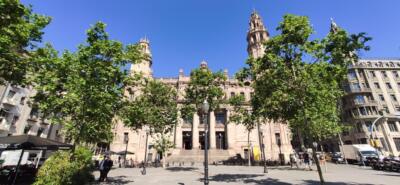
Bureaucracy Never Looked So Beautiful – Edificio de Correos y Telégrafos (Central Post Office)

Barcelona’s Edificio de Correos y Telégrafos, or Central Post Office, might be the only place where sending a package feels like stepping into a palace. Tucked between the bustling...

More
Neo-Gothic Bishop’s Bridge crossing Carrer del Bisbe in Barcelona’s Gothic Quarter, with ornate stonework and pointed arches.

Gothic Illusion in a Neo-Gothic Frame – Bishop’s Bridge

It looks centuries old, but Pont del Bisbe, or Bishop’s Bridge, is not quite what it seems. Spanning a narrow street in the Gothic Quarter like a stone whisper...

More
Roy Lichtenstein's colorful sculpture "El Cap de Barcelona" near Passeig de Colom with historic buildings in the background.

Pop Art Meets Port – Lichtenstein’s Face of Barcelona – Cap de Barcelona

Amidst the Roman ruins and medieval shadows of Barcelona’s Old Town, there’s one face that couldn’t care less about blending in. Roy Lichtenstein’s Cap de Barcelona, a 15-meter pop-art...

More
Plaça Antonio López in El Born, Barcelona, with view of the Llotja de Mar building and the empty pedestal where a removed monument once stood.

The Deal-Making Hall That Time Transformed – La Llotja de Barcelona

Long before skyscrapers and stock markets, La Llotja de Barcelona was where real business happened. Built as a medieval exchange hall just steps from the sea, this grand structure...

More
Rear view of the apse and bell tower of Barcelona Cathedral from Carrer de la Pietat, showing Gothic windows and gargoyles.

The Gothic Giant That Guards the Old City – Barcelona Cathedral

Rising above the winding alleys of the Gothic Quarter, the Barcelona Cathedral is a monumental blend of piety and power. Dedicated to Saint Eulàlia, the city’s co-patron saint, this...

More
Historic stone drinking fountain with three carved faces in Plaça Sant Just, Gothic Quarter, Barcelona.

The Oldest Fountain Still Flowing – Font de Sant Just

Tucked into a quiet corner of the Gothic Quarter, the Font de Sant Just is one of Barcelona’s oldest public fountains. Built in the 14th century in Gothic style,...

More
Architecture
Humble to Icon

The City That Built Itself Beautiful

Barcelona is a city written in stone, brick, and tile. From Roman columns hidden in courtyards to the sculpted fantasies of Gaudí and the sharp lines of modern towers, each era left a mark you can still touch. Scroll through the centuries and discover how architecture has shaped the city, and how the city, in turn, shaped architecture.

Iberian Period-600 BCE

Laietani Settlements

Before the Romans, the Laietani built small, fortified hilltop villages (oppida). No structures survive in Barcelona today, but archaeological traces on Montjuïc and surrounding areas point to their presence.

-600 BCE
Roman Arrival-200 BCE

Roman Foundations

Barcino is built with defensive walls, a forum, and temples in classic Roman style. You can still visit the Temple of Augustus and remains beneath the city today.

-200 BCE
Christianization of Barcino300 CE

Early Christian Adaptations

As Christianity spreads, some Roman spaces are reused or adapted into religious buildings. Archaeological traces of early Christian homes and places of worship exist, but little survives above ground.

300 CE
Visigothic Era400 CE

Fragmented Foundations

Little architectural innovation. Some churches likely built, but none remain visible. Roman infrastructure is reused. The city contracts within the old Roman wall.

400 CE
Muslim Conquest700 CE

A Lost Islamic Layer

Muslim control is brief and leaves no surviving architecture in Barcelona. If a mosque or administrative buildings existed, they were likely destroyed or built over.

700 CE
Carolingian Rule800 CE

Fortification and Reuse

The Carolingians reinforce the Roman walls. Some Christian churches are rebuilt or newly constructed, but materials are modest, and few structures survive. The city remains small and inward-looking.

800 CE
Early Medieval Period1000 CE

Romanesque Beginnings

Modest Romanesque structures appear. Sant Pau del Camp is the key surviving example. Stone replaces wood in churches and monasteries, but the architectural footprint remains limited.

1000 CE
Gothic Emergence1100 CE

The Gothic Quarter Takes Shape

Barcelona gains wealth and civic ambition. Catalan Gothic churches, palaces, and public buildings dominate. Key examples: Santa Maria del Mar, Barcelona Cathedral, Plaça del Rei, and royal palaces.

1100 CE
Unified Spain1500 CE

Renaissance Quietude

Architecture slows under centralized Castilian rule. Some late Gothic and Renaissance elements appear, but few major buildings are constructed in Barcelona during this time.

1500 CE
Bourbon Rule and Neoclassicism1700 CE

Rebuilding Under Control

After the 1714 fall of Barcelona, the Bourbons impose Neoclassical order. Structures like La Llotja de Mar and Plaça Reial reflect French influence and urban regularization.

1700 CE
Industrial Expansion and Modernisme1800 CE

The Architectural Renaissance

Barcelona explodes with creativity. Modernisme leads the way, producing icons like Casa Batlló, Sagrada Família, and Hospital de Sant Pau. The Eixample grid transforms the city’s scale and character.

1800 CE
Dictatorship and Control1900 CE

Architecture Under Franco

Barcelona explodes with creativity. Modernisme leads the way, producing icons like Casa Batlló, Sagrada Família, and Hospital de Sant Pau. The Eixample grid transforms the city’s scale and character.

1900 CE
Contemporary Barcelona2000 CE

Contrast and Innovation

Post-Olympic Barcelona embraces modern materials, bold design, and sustainable architecture. Landmarks include Torre Glòries, MACBA, and the Design Hub. New layers rise alongside the old.

2000 CE
Unimportant
Becoming great, slowly

From Fringe Town to Global Icon

For over a thousand years, Barcelona lived in the shadow of bigger names:

  • Not a Roman capital like Tarraco (Tarragona)

    While Barcino was founded as a Roman colony around 15 BCE, it was always a small sibling to Tarraco (modern Tarragona), the capital of Roman Hispania Citerior. Tarraco hosted emperors, governed vast territories, and displayed monumental architecture. By contrast, Barcino remained a modest port town with walls, a forum, and some villas, more strategic than grand. Its real legacy was survival, not status.

  • Not a Visigothic center like Toledo

    During the Visigothic period, political and religious power centred in Toledo, far to the west. Though Barcino briefly gained attention when King Ataulf made it his capital in 415 CE, that moment passed quickly. The city returned to quiet provincial life, without the major councils, churches, or royal backing that elevated other Visigothic cities. Most of what was built then has vanished beneath later layers.

  • Not a major Muslim city like Granada, Córdoba or Zaragoza

    When Muslim forces swept across Iberia in the early 8th century, Barcelona was conquered but never flourished under Islamic rule. Unlike Córdoba, which became a dazzling Caliphate capital, or Zaragoza, which thrived as a powerful taifa kingdom, Barcelona remained a border city, briefly held and quickly reclaimed by the Franks in 801 CE. Its Islamic past left few physical traces, but helped define its role as a Christian frontier post.

  • Not the royal court of its own Crown; that was Valencia and Naples

    Even at the height of Catalan-Aragonese power in the late medieval period, Barcelona was not the seat of the court. As the Crown of Aragon expanded into Valencia, Sicily, and Naples, the royal family followed power and trade southward. Courts were held in Valencia and later in Naples, not Barcelona. The city remained wealthy and influential — but political gravity pulled elsewhere.

And yet, Barcelona endured, quietly, persistently, creatively.

It became a city where walls became homes, where churches rose atop Roman ruins, and where a 19th-century explosion of imagination and industry redefined what a city could be.

Barcelona’s true ascent began in the late medieval period, but its transformation didn’t ignite until the Industrial Revolution and the rise of Modernisme.

That long, modest stretch of obscurity is what makes the city’s rise so powerful today. This is not a city frozen in glory. It’s a city that earned its beauty and grew into its greatness.

Pictures
Direct from Our Cameras

Photos of our Beloved Barcelona

All the photos you see here were taken by us, your local guides who host our walking tours across Barcelona. Most are snapshots from real experiences with our guests, capturing the authentic beauty of the city’s neighborhoods, from the Gothic Quarter to Gaudí’s landmarks. Use the filters to explore images from specific tours and discover what makes each area unique.

This is for You

Who This Tour Is For (And Not For)

  • Want to start your trip with context and orientation

    This is the key to understanding Barcelona: how the city fits together, what’s worth your time, and why the past still shapes everything you see today.

  • Love history, storytelling, and street-level detail

    If you light up at a good story and want to actually feel the centuries beneath your feet, this tour turns history into something you can almost touch.

  • Enjoy walking and discovering hidden corners

    You don’t just want highlights; you also want the tucked-away courtyards, mysterious alleyways, and quiet gems that most visitors never find.

  • Prefer small groups and personal connection

    You’d rather travel with a curious little crew and a real human host who listens, laughs, and tailors the experience to the moment.

  • Are curious about Barcelona’s origins, not just its icons

    You want to uncover the layers and reach the roots: Romans, rebels, saints, and the stories that shaped Barcelona long before the tourists arrived.

  • Want to explore the Gothic Quarter, not Gaudí

    This is the old Barcelona: shadowy legends and stone passageways. No wavy facades or tiled dragons on this one, but we love those, too.

  • You’re looking for a Gaudí or Sagrada Família tour

    That’s a totally different journey into Barcelona’s architectural imagination, and yes, we offer that too, just not on this route.

  • You dislike walking or standing outdoors for 2+ hours

    We’re on our feet for the full experience, strolling through narrow streets and stopping often, but the city itself is our only backdrop.

  • You want in-depth architecture theory or academic detail

    This is not a lecture with footnotes; it’s more street theater than seminar, with just enough nerdy bits to keep it sharp and surprising.

  • You’re hoping to visit interiors of major monuments during the walk

    We don’t go inside churches or museums; our focus is on the stories that surround them, in the streets where it all really happened.

  • You're expecting a quick photo-op style tour without storytelling

    This is not a checklist or selfie circuit; it’s a slow reveal, where you hear the why and the wow behind each place we pause.

  • You prefer audio headsets or large group formats

    If you’re after a tour with twenty people and a headset, this probably isn’t your scene. We’re all about real interaction, not recordings.

Questions
FAQ

Frequently Asked Questions

What sights will we see on the tour?

This isn’t your typical history tour. We wander through the winding streets of Barcelona’s Old Town with stories that bring 2,000 years of history to life, from Roman ruins and medieval legends to forgotten queens and everyday locals who shaped the city. You’ll pass by places like Plaça Sant Jaume, the exterior of the Barcelona Cathedral, and plenty of hidden spots most tourists walk right past. It’s not about ticking off monuments, it’s about connecting with the soul of the city.

How long is the tour and how much walking is involved?

The tour lasts around 2.5 to 3 hours. The pace is relaxed, with plenty of stops for stories, questions, and water. We cover about 2.5 kilometers (1.5 miles) on foot, mostly on flat ground with some cobblestones.

Where does the tour start and end?

We start at Plaça de Correus, right on the edge of the Gothic Quarter near the old port. The end point varies depending on the guide, the season, the weather, and what’s happening in the city that day. It’s always within the Gothic Quarter and never more than a 10-minute walk from where we began.

Do I need to book in advance?

Yes, advance booking is essential. We keep our groups small, and some tours sell out ahead of time. Booking early guarantees your spot and helps us keep the experience personal.

How do I pay for the tour?

Payment is required in full when you book. It’s quick and secure, and guarantees your spot on the tour. Once you're confirmed, just show up, we'll take care of the rest.

What language is the tour in?

All our public tours are in English. If you're looking for Spanish, Catalan, German or another language, just get in touch and we’ll let you know about private tour options.

Is this tour suitable for kids, seniors, or people with mobility concerns?

Yes. The route is step-free and mostly flat, and our hosts adjust the pace to suit the group. If someone in your group uses a wheelchair or has limited mobility, let us know in advance and we’ll make sure everything works for you.

What should I bring or wear?

Wear comfortable shoes and dress for the weather. In summer, bring water, sun protection, and a hat. In cooler months, bring a jacket. We run tours in light rain, so a small umbrella or waterproof layer can be useful too.

Does the tour run in bad weather?

Yes. We run rain or shine, unless the weather becomes unsafe. If we ever need to cancel due to extreme conditions, we’ll contact you as early as possible with options.

How big are the groups?

Group size is capped at 10 people. On average, we host 5 to 7 guests per tour. Small groups mean more flexibility, better storytelling, and time for real conversations.

Can I book a private or custom version of this tour?

Absolutely. Whether you're a couple, a family, or a group of colleagues, we can tailor the experience to your pace and interests. Private tours can also include extras like food stops or special themes. Just reach out and tell us what you’re looking for.

Do you pick up at my hotel or appartment?

No, we don’t offer hotel pick-up. The meeting point is central and easy to reach by metro, taxi, or on foot. Once you book, you'll get detailed instructions and a map link to help you get there stress-free.

Do we go inside any buildings on the tour?

No, the experience is fully outdoors. This gives us the flexibility to explore more of the Gothic Quarter without waiting in lines. Your host will point out places worth visiting afterward and give tips on how to skip the crowds.

Can I bring my child on the tour?

Absolutely. Kids are welcome as long as they’re comfortable walking for about two hours and enjoy storytelling. If you're traveling with toddlers or strollers, let us know and we’ll adapt the route as best we can.

Do you cover the Spanish Civil War or Jewish history?

Yes, we touch on all of those, but the depth may vary depending on your host and the group’s interest. If there’s something you’re especially keen to hear about, feel free to tell your host at the beginning of the tour.

Are there bathroom breaks during the tour?

There are no scheduled stops, but your host will happily point out clean, free bathrooms nearby before or after the tour.

Can I join the tour if I arrive late?

It’s your responsibility to be on time. We’ll send you a reminder before the meeting time to help you stay on track.

To be clear: If you’re late, there’s no way to catch up or reschedule once the tour has started. During the tour, I’ll fully focus on creating a great experience and won’t check my phone out of respect for other participants. So, please plan and arrive early!

Can we take photos during the tour?

Yes, definitely. There will be plenty of scenic and quirky moments along the way. Just be respectful of others in the group and avoid blocking narrow alleys.

Can I bring my dog?

Yes, please! We loooove dogs. As long as your pup is well-behaved, on a leash, and comfortable in small groups and urban environments, they’re more than welcome to join the walk. Just give us a heads-up when booking so your host knows to expect furry company.

How well do the hosts speak English?

All our hosts speak English fluently and confidently, at near-native level. While none of us are native speakers, we’ve been guiding international guests for years, and we communicate clearly, naturally, and with a lot of personality.

Are you locals?

Yes, we’re all proud locals. Some of us were born and raised in Barcelona, others have called it home for over a decade. We know the city like the back of our hand and love sharing stories you won’t find in the guidebooks.

Is this tour going to Sagrada Família?

No, this tour takes place entirely in the Old Town, far from the Sagrada Família. If you're looking to explore Gaudí’s masterpieces, check out our Gaudí walking tour, which includes Casa Batlló, Casa Milà, and a close-up of the Sagrada Família.

Will we see any famous buildings by Gaudí?

Not on this tour. Gaudí’s work is found in the Eixample and Gràcia neighborhoods, not in the Gothic Quarter. This tour focuses on Roman ruins, medieval palaces, and hidden gems from Barcelona’s earlier history.

Do we need a ticket to attend the tour?

No physical ticket is needed. Once you book online and receive your confirmation email, you’re all set. Just show up at the meeting point on time, no printouts, no QR codes, no fuss.

Host
Matt

Meet a co-Founder

Hi, I’m Matt, co-founder of myBCN. I was born in Germany, raised in Sweden, and have been living in Barcelona for over 20 years. I’m an engineer by training, a guide by profession, and a heritage nerd at heart. I’ve always been obsessed with architecture, history, and the kind of travel that connects people to place.

Together with Jana, I started myBCN to create experiences that go deeper. I don’t believe in scripted tours or checklist sightseeing. I believe in stories, context, conversation, and those moments when something clicks and you feel the city. Whether I’m leading a walk through the Gothic Quarter or building out a new experience behind the scenes, I’m always chasing those moments of discovery.

I’ve been to more than 50 countries and visited over 350 UNESCO World Heritage Sites. I’m on a mission to visit them all. You can follow that journey on Instagram at @GuideVenturous.

Our Guests
This is What We are Doing

Barcelona Moments in Motion

Want a taste of what it’s like to join one of our Barcelona walking tours? Watch our Instagram Reels to experience moments from our tours, this time scripted but still unfiltered, and full of life. From Gaudí close-ups to Old Town surprises, these short clips capture the atmosphere, storytelling, and laughter that define the myBCN experience. Follow us on Instagram to see more and feel the spirit of Barcelona in every frame.

Our Guests
What Our Clients Are Saying

Here’s What Our Guests Think

We believe the best way to explore Barcelona is through powerful storytelling, and our guests agree. These reviews reflect what truly sets myBCN apart: hosts who bring the city’s history to life with humor, heart, and deep local insight. Every walking tour is more than a list of facts; it’s a meaningful journey that connects the past with today’s vibrant Barcelona. Read what travelers have shared after experiencing it first-hand.

Share Your Own Insights

Give us your Insights in a Review on:
Give us your AI Assisted Insights in a Review on: